




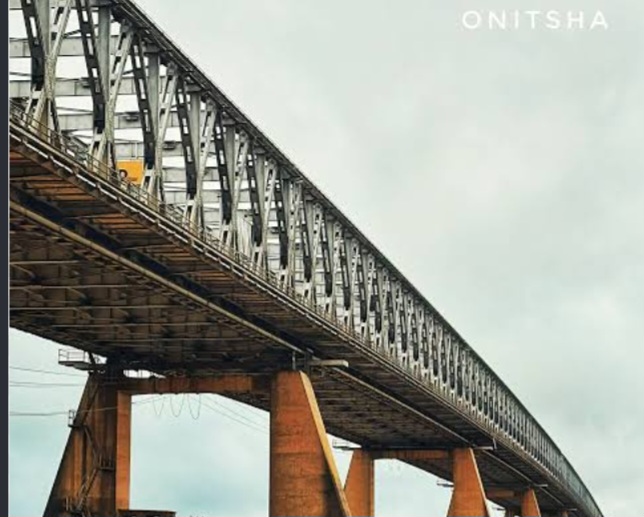

It is a pity that we are discussing this now.
When I saw the latest Facebook post showing vandals allegedly removing the bolts and nuts holding the River Niger Bridge together, I was deeply worried.
Not merely because of the immediate danger, but because of what it says about us as a people. For over half of a century, people of our zone and those who love us have made frantic appeals for the Niger Bridge. Now that it has been done, we show how unserious we were about it!
More troubling is the fact that this is not an isolated incident.
Only a few weeks earlier, on the same Facebook platform, I saw reports and images of the natural devastation affecting sections of the Second Niger Bridge. As in the current one on the Niger Bridge, a citizen reporter brought it to the fore through social media.
These came on the heels of social media materials that circulated 2023 through 2024 – showing scavengers and vandalisers allegedly cannibalising speed brakes, side rails and metal components along the Second Niger Bridge bypass.
These are only a few examples of what may be happening across the South-East — unnoticed, unreported or reported too late. But note that it’s just one or two social media attention on one development that attracted this vast attention.
As I type this message, Arise TV is discussing the River Niger vandalism.
And that is perhaps the most disturbing part.
We are increasingly becoming spectators to the destruction of infrastructure that has taken enormous public resources, years of planning and considerable sacrifice to provide. Worse still, it appears to the rest of the world that we have a collective silence on the matter.
This risks making the people of the zone appear aloof, indifferent and disgustingly unconcerned about developments that should command their immediate attention.
There are even people who interpret such vandalism as an expression of popular disenchantment with the Federal Government. What could be more dangerous — or more disturbing — than that?
Whether or not that sentiment is widespread, it is being expressed. And we must confront it honestly.
Infrastructure is not the property of government. It is the property of the people. It is the property of the host community and state. Its maintenance or disregard tells the world a lot about the host.
A bridge is not merely concrete, steel, bolts and rails. It is an economic artery. It connects communities and states, facilitates commerce, supports livelihoods and carries people to their destinations. Destroying it is not an act of protest; it is an assault on our collective future.
What must we do?
The solution requires a combination of enforcement, civic education and ensuring the existence and support of responsible journalism.
First, establish permanent security patrols on the bridges.
A joint task force comprising the Police and the Nigeria Security and Civil Defence Corps should patrol the River Niger Bridge and the Second Niger Bridge and their approaches round the clock. Critical infrastructure cannot be left virtually unguarded until vandals have done irreparable damage.
Security surveillance, lighting, rapid-response mechanisms and appropriate technological monitoring should complement physical patrols.
Second, the South-East must take civic orientation seriously.
Every state should have a strong citizens’ orientation agency with the resources and mandate to educate residents about their civic responsibilities and the need to protect public infrastructure.
Truth is that whenever people descend on public facilities, under any excuse, it is crime, punishable by law. It is also like cutting one’s nose to spite his face.
People must understand that stealing a bolt from a bridge is not a victimless crime. Damaging a public facility is not an attack on an abstract government. It is an attack on ourselves.
Civic responsibility must become part of our everyday culture.
Most importantly, we need a stronger South-East Nigeria media presence, nationally and internationally.
The people of the South-East must build and sustain frontline media organisations capable of competing with the strongest media institutions anywhere in Nigeria.
A vigorous regional media is not merely about telling our stories. It is about protecting our society.
A strong media will expose vandalism and other criminal activities before they become catastrophes that will attract shame to all of us. It will scrutinise government negligence and deliberate wrongdoing. It will investigate abandoned projects, expose waste and demand accountability — regardless of who is responsible.
It will also educate citizens, promote civic consciousness, stimulate development and ensure that issues affecting the region are not buried in the noise of national discourse.
The South-East cannot afford to be a region where everything is discussed only after disaster has occurred.
We need to see.
We need to speak.
We need to report.
We need to act.
Let us stop treating the destruction of public infrastructure as somebody else’s problem.
The River Niger Bridge belongs to all of us. The Second Niger Bridge belongs to all of us. The roads, schools, hospitals, markets, waterways and other public assets across the South-East belong to all of us.
If we do not protect what we have, we cannot credibly demand more.
This is therefore a call to governments, security agencies, traditional institutions, community leaders, the media, civil society organisations and, above all, ordinary citizens:
Protect our infrastructure. Report vandals.
Challenge negligence. Demand accountability.
The South-East must not wait for a bridge to collapse before we discover that we should have been watching.
●Nnabuife is a Fellow of the Nigerian Guild of Editors and writes from Awka